
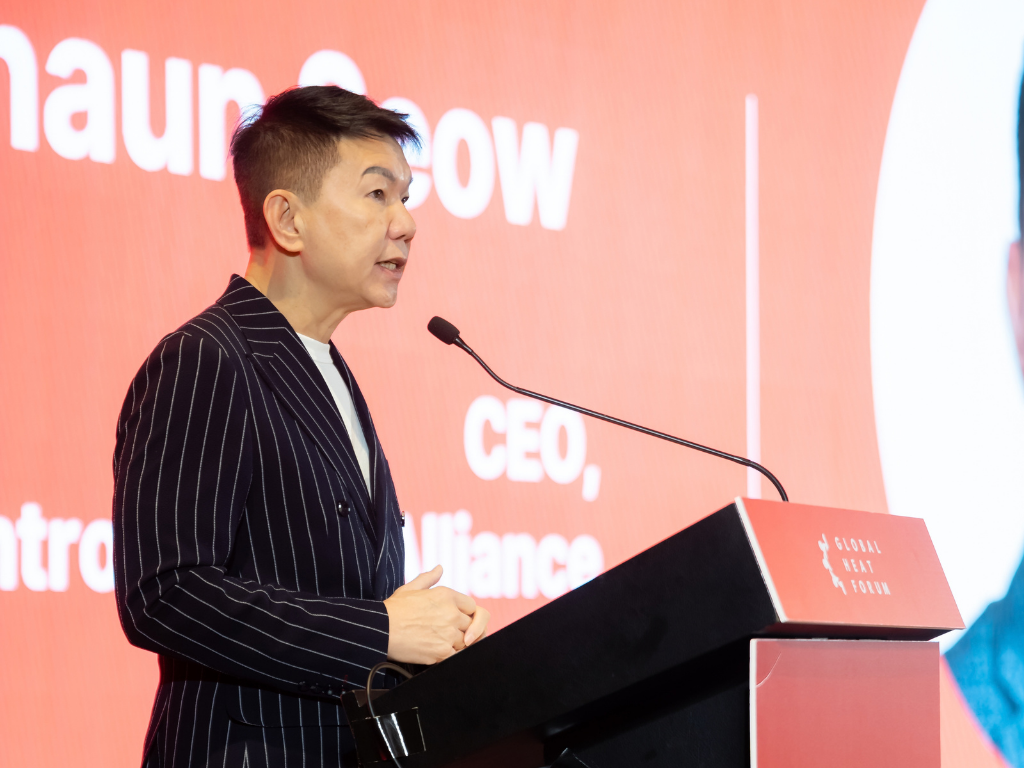
Good morning, distinguished guests, partners and friends.
It is a pleasure to join you here in Bangkok, although we gather at a sobering time for the city.
Just days ago, Bangkok experienced some of its most severe flooding in years, disrupting daily life, businesses and livelihoods, and underscoring once again of the growing climate risks we face.
While we are gathered here to discuss extreme heat, the recent floods are another reminder of the need to strengthen our resilience to a shifting climate.
Floods are immediately visible. Extreme heat can be less so.
Yet its impact is just as real.
Extreme heat is a growing challenge worldwide, including here in Asia.
Home to more than half the world's population and some of its fastest-growing cities, Asia faces significant risks as rising temperatures threaten the health, livelihoods and well-being of millions.
For a construction worker, extreme heat can mean unsafe working conditions.
For a farmer, it can mean shorter working hours and lower yields.
An elderly person, serious health risks, even within their own home.
Multiply these impacts across entire communities, and we are looking at lost livelihoods, reduced productivity and growing costs to our economies.
The good news is that a great deal of work is already happening.
Scientists are advancing our understanding of heat risks.
Cities are developing heat action plans.
Businesses and communities are finding new ways to protect workers and vulnerable populations.
Many of you in this room are leading these efforts.
But how do we take all this good work to the next level?
How do we move from protecting hundreds of thousands of people to hundreds of millions?
I would like to offer three thoughts on what it will take to achieve that scale.
First, we need to institutionalise heat resilience.
Many of the solutions we need already exist.
But too often, they remain individual projects or pilots, dependent on dedicated funding or the isolated efforts of organisations.
If we want to reach millions of people, we need to move beyond standalone interventions.
We need to embed heat resilience into the policies, institutions and systems that people rely on every day.
Take Ahmedabad in India.
Following a deadly heatwave in 2010, the city introduced South Asia's first Heat Action Plan in 2013.
It brought weather warnings, hospital preparedness and community outreach into a coordinated city-wide response.
An evaluation subsequently estimated that the plan helped avert around 1,200 deaths a year.
Since then, heat preparedness has expanded across India, with more than 250 cities and districts across 23 states now having operational Heat Action Plans.
What made the difference was not a single intervention.
It was bringing different measures together into a system that could be activated and sustained year after year.
Singapore, where I am based, is taking a similar whole-of-government approach.
The country already has heat measures spanning urban planning, workplace safety, schools and healthcare.
Also, a national heatwave response plan involving more than 30 government agencies and ministries.
More recently, the Singapore government established a dedicated Heat Resilience Policy Office to coordinate these efforts and develop a national Heat Resilience Action Plan across infrastructure, health, economic and social sectors.
The lesson is clear.
Heat resilience cannot remain a collection of separate initiatives.
It needs to become part of how our cities and societies function.
Heat needs a clear owner, but it also needs many hands working together.
Institutionalising these efforts is what allows solutions to be delivered consistently, sustained over time and, ultimately, extended to many more people.
Second, we need to localise solutions.
Heat risks vary considerably across cities and communities.
A construction worker, a market trader and an elderly resident... they may live in the same city, but face very different risks and have very different needs.
This means we cannot simply take a solution that works in one place and assume it will work everywhere.
The most effective solutions combine scientific evidence with local knowledge, bringing together researchers, governments, practitioners and communities, and making them understand the risks and develop responses that work on the ground.
Take Freetown in Sierra Leone.
Women working in informal markets face prolonged exposure to extreme heat, often with little access to shade or cooling.
Rather than impose a solution, the city worked with these market traders to understand the conditions they faced.
That led to practical responses, including shaded market spaces.
Those most affected helped design the intervention and oversee its installation.
This meant the response reflected how people actually worked and used these spaces.
But how do we make this kind of collaboration happen more consistently across different cities and communities?
We need to bridge the gap between scientific knowledge and local action.
And we need to build the capabilities that allow cities to respond to heat risks over the long term.
This is particularly important in Southeast Asia, where heat risks are rising rapidly.
That is why I am pleased to announce Philanthropy Asia Alliance’s commitment to supporting the Global Heat Health Information Network's Southeast Asia Hub.
The hub is hosted by the Heat Resilience and Performance Centre at the National University of Singapore’s, Yong Loo Lin School of Medicine.
Our ambition is to help translate scientific evidence on heat and health into practical action, which will then strengthen local expertise and capabilities across the region.
In Indonesia, for example, the Ministry of Health and WHO agencies recently launched KATALIS-HEAT.
This is in collaboration with the GHHIN Southeast Asia Hub, the Ministry of Environment and Indonesia's meteorological agency.
Supported by our partner, The Rockefeller Foundation, the initiative brings together government agencies and local universities to assess heat-related health risks.
It also pilots municipal heat-health action planning and informs a national roadmap.
We are looking to build on this work together with the Rockefeller Foundation, drawing on the Hub's expertise to help move scientific evidence into practical, locally relevant action.
Ultimately, localisation is about ensuring that solutions are grounded in local realities, and that cities and communities have the capabilities, agency and ownership to carry them forward.
Third, we need to mobilise resources at scale.
Even when we know what works, finding the resources to deliver solutions at scale remains a major challenge.
Part of the difficulty is that the benefits of heat resilience are often widely shared, while the financial returns are less obvious.
Consider urban greening.
Planting trees and creating shaded public spaces can reduce heat exposure, improve health and make cities more liveable.
The benefits are shared by residents, workers, businesses and the wider community.
Yet there may be no direct revenue stream for an investor to capture.
This is why we need to think more deliberately about how different sources of funding and capital can work together.
Philanthropy has an important role to play.
We can take early risks, test new approaches and help establish the evidence for what works.
Governments can embed proven interventions into public infrastructure and services.
Development banks can help finance larger programmes while businesses and private investors can contribute where commercially viable opportunities exist.
Each has a different role, and not every solution will lend itself to private investment.
But philanthropy itself also needs to work more collectively if we are to make the most of our resources.
One example for this approach in action is the Climate and Health Funders Coalition, which brings together more than 35 philanthropic organisations.
It recently announced an initial US$300 million commitment at COP30, aligning resources and expertise around shared climate and health challenges, including extreme heat and climate-sensitive infectious diseases.
This US$300 million commitment is an important start.
But the scale of the challenge demands that we use these resources to unlock much more.
The real test is what this funding makes possible.
Can we demonstrate solutions that governments can adopt and sustain?
Can we reduce the risks that prevent larger investments from flowing?
Can we develop models that can be replicated across hundreds of cities, rather than remaining confined to a handful of pilots?
Our ambition should not be to fund more heat resilience projects.
It should be to unlock the resources needed to protect populations at scale.
Let me leave you with three words.
Institutionalise. Localise. Mobilise.
Over these three days, we have discussed the science, shared experiences and explored solutions.
We know a great deal about what needs to be done. The challenge now is to put that knowledge to action.
To institutionalise what works, so that solutions endure.
To localise them, so they reach the people who need them most.
And to mobilise the resources to deliver them at scale.
We came here to advance the heat agenda.
Let us leave with the partnerships, ambition, and determination to move from protecting hundreds of thousands of people... to HUNDREDS OF MILLIONS.
Thank you.


.tmb-.jpg?Culture=en&sfvrsn=abf428e0_1)

.tmb-.jpg?Culture=en&sfvrsn=28bcf165_1)


-(2).tmb-.jpg?Culture=en&sfvrsn=71ee5456_1)

.tmb-.jpg?Culture=en&sfvrsn=6c4029d4_1)
.tmb-.png?Culture=en&sfvrsn=b8708911_1)
.tmb-.jpg?Culture=en&sfvrsn=8f801359_1)